Is Modern Life Metabolically Damaging?
Struggling with digestion, weight, or blood sugar despite eating well? Explore my perspective on how nervous system health and modern stress impact metabolic function.
6 min read


Is Modern Life Metabolically Damaging?
You eat well.
You choose whole foods, try to prioritise protein, and make an effort to look after your health.
Yet your digestion still feels unpredictable. Your weight won't shift. Your blood sugar is creeping up. Or perhaps you simply don't feel as well as you think you should.
If this sounds familiar, you're not alone.
For many people, the missing piece isn't another diet or more willpower. It's understanding how the modern environment interacts with our nervous system, and how that relationship influences metabolism, digestion, and long-term health.
Your Nervous System Is Running More Than Your Mood
We often think about metabolism in terms of calories, hormones, and food choices. But metabolism doesn't operate in isolation.
Every second of the day, your autonomic nervous system is gathering information from your environment and asking one important question:
"Am I safe enough to prioritise digestion, repair, and long-term health, or do I need to prioritise survival right now?"
The answer influences:
Digestion and nutrient absorption
Blood sugar regulation
Insulin sensitivity
Gut motility
Appetite and cravings
Fat storage
Inflammation
Cellular repair
In other words, your nervous system helps decide whether your body invests energy in thriving or temporarily shifts resources toward getting through a perceived challenge.
The Body's Survival States: An Evolutionary Advantage
Our nervous systems evolved to help us survive genuine threats.
If our ancestors encountered danger, their bodies rapidly shifted into survival mode.
Heart rate increased. Blood was redirected to muscles. Energy stores were mobilised.
These responses are incredibly intelligent, and lifesaving when we truly need them.
Research from scientists such as Elissa Epel has demonstrated that chronic activation of these survival pathways can influence everything from cellular health to metabolic function over time.
And we have Stephen Porges's Polyvagal Theory offering a useful clinical framework for understanding how nervous system states influence the gut-brain connection. While some neuroscientists debate aspects of the theory's evolutionary origins, many clinicians find it profoundly helpful for understanding digestive symptoms, trauma, and chronic illness presentations. So, I thought you might too.
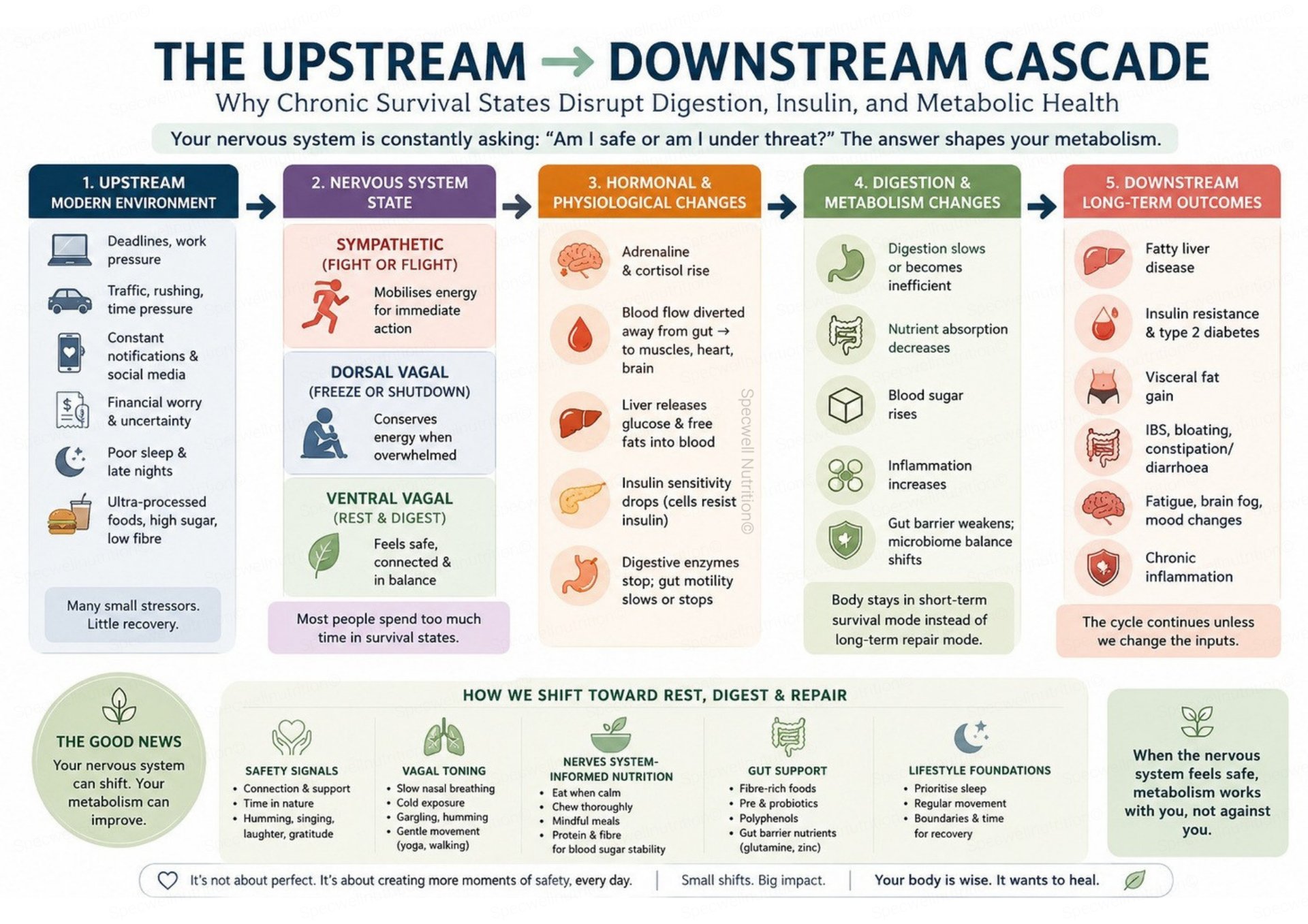
The Upstream → Downstream Cascade
When the nervous system detects challenge, a predictable physiological cascade unfolds. Cue the sound of those internal horns blaring, it might be for “Ugh, where’s my phone?” or “Uh oh, this doesn’t feel right” that flicker of panic that sends your heart rate up and your digestion down before you’ve even had your morning coffee. Or maybe it’s “I’m late again,” “Did I send that email?”, “Why’s my kid not answering?”, “They’re looking at me,” “My stomach’s doing that thing again,” “The bill’s higher than I expected,” “Traffic’s closing in,” or “I forgot to reply.”
I could keep going, but I’m sure you’re already get it. Got it and Oh so familiar. These moments feel small on their own, but together they’re enough to nudge your nervous system into survival mode, diverting blood from digestion, spiking cortisol, and reducing insulin sensitivity. Over time, they keep you in a low-grade fight-or-flight loop without you even noticing. Darn body, trying to protect me like a overzealous security guard. Love you, but dang… I literally just needed to find my phone, not mobilise for war.
Sympathetic State: Fight or Flight
In a sympathetic state, adrenaline and cortisol rise.
The body temporarily prioritises immediate survival over longer term functions such as digestion and repair.
This means:
Blood flow is diverted away from the digestive tract and toward the brain, heart, and muscles.
The stomach and intestines may slow down, altering motility and digestive enzyme secretion.
The liver releases stored glucose and fatty acids into the bloodstream to provide rapid fuel.
Insulin sensitivity is temporarily reduced so that glucose remains available for tissues that may need it urgently.
This response is adaptive and protective in the short term.
Dorsal Vagal State: Freeze or Shutdown
When challenges become overwhelming or prolonged, some people may shift into what Polyvagal Theory describes as a dorsal vagal state.
This state is characterised by conservation of energy and reduced physiological output.
Clinically, people may experience:
Slowed digestion or altered bowel habits
Reduced appetite or, conversely, comfort eating
Fatigue and low motivation
Increased digestive sensitivity
Changes in gut motility
Although sympathetic activation and dorsal vagal shutdown represent different physiological states, both can disrupt normal digestive processes.
Ventral Vagal State: Rest, Digest, and Repair
When the nervous system perceives safety, the ventral vagal system predominates.
This is the state in which the body is most able to:
Efficiently digest and absorb nutrients
Maintain healthy gut motility
Support gut barrier integrity
Regulate blood sugar effectively
Respond appropriately to insulin
Invest energy in repair and recovery
Put simply, metabolism tends to function most efficiently when the body receives consistent signals that it is safe.
The Adrenaline and Cortisol Baseline Problem
The challenge is that modern life rarely resembles the environment our biology evolved within.
Our ancestors typically experienced acute stressors followed by periods of recovery.
Modern challenges are often different.
Emails.
Traffic.
Deadlines.
Financial pressures.
Constant notifications.
Information overload.
Individually, these experiences may seem small. Collectively, they can keep the nervous system in a prolonged state of vigilance.
Researchers increasingly recognise that repeated exposure to these "micro-stressors" may prevent the body from fully returning to a restorative, rest and digest state.
Many people spend years existing in a low-grade survival loop without realising it.
This isn't a personal failing.
It's simply the result of ancient biology interacting with a very modern world.
Importantly, the nervous system does not always automatically reset once a challenge has passed. We often need experiences, behaviours, and environments that actively communicate safety back to the body.
The Double Hit: When Modern Diet Meets Modern Nervous Systems
Nervous system dysregulation is only part of the story.
Insulin resistance, fatty liver disease, and digestive disorders are multifactorial conditions influenced by genetics, sleep, physical activity, environmental exposures, and dietary patterns.
However, when chronic autonomic activation combines with a modern hyper-processed food environment, we create what could be considered a "double hit." bada bing bada...boom.
On one hand:
Survival physiology promotes higher circulating glucose and reduced insulin sensitivity.
Digestive efficiency may decline.
Inflammation may increase.
On the other:
Hyper or Ultra-processed foods are often rapidly absorbed, highly palatable, and lower in fibre and protective nutrients. (things that typically come in boxes and bags )
Excess energy intake becomes easier.
The gut microbiome may become less diverse.
Together, these factors can contribute to:
Insulin resistance
Fatty liver disease
Blood sugar dysregulation
Digestive symptoms such as bloating and IBS
Changes in appetite regulation
Food matters in a major way.
But so does the physiological environment in which that food is eaten.
Why Some People "Do Everything Right" and Still Struggle
One of the most validating things I tell clients is this:
You can be eating an excellent diet and still struggle if your nervous system and metabolism are not receiving the signals they need to shift into repair mode.
Nutrition does not occur in a vacuum.
How, when, and in what physiological state we eat can influence digestion, absorption, blood sugar regulation, and symptom experience.
This is often the missing puzzle piece for people who feel frustrated because they are "doing all the right things."
Bridging the Gap Between the Nervous System and Metabolic Health
As a Clinical Nutritionist, my role extends beyond simply prescribing foods or supplements.
Together, we explore the many factors shaping your metabolic health, including:
Nervous system informed meal timing and eating practices
Personalised strategies to support vagal tone and autonomic flexibility
Gut barrier and microbiome support
Blood sugar regulation
Sleep, recovery, and lifestyle patterns
Individual nutrition strategies that fit your unique physiology
Because sustainable health rarely comes from focusing on food alone.
When we support both the nervous system and metabolism together, many people discover that their bodies begin responding in ways they hadn't thought possible.
No wellness perfectionism here. Life is messy, bodies are complex, and I'm a realist who will always keep it real with you. I often say the phrase, "the more you know..." so I guess this post is for those who want to understand the hidden influences that may be shaping their health.
Hope you have a grounded day!
X Natasha
Further Reading:
Epel, E. S., Crosswell, A. D., Mayer, S. E., Prather, A. A., Slack, J. A., Conklin, Q. A., ... & Mendes, W. B. (2018). More than a feeling: A unified view of stress measurement for population science. Frontiers in Neuroendocrinology, 49, 146–169. https://doi.org/10.1016/j.yfrne.2018.03.001
Espinoza, D., Seibold, F., & Stanley, S. (2025). Central and peripheral neural circuits regulating glucose homeostasis. npj Biomedical Innovations, 3, 34. https://doi.org/10.1038/s44385-025-00036-8
Porges, S. W. (2025). Polyvagal theory: A journey from physiological observation to neural innervation and clinical insight. Frontiers in Behavioral Neuroscience, 19, 1659083. https://doi.org/10.3389/fnbeh.2025.1659083
Porges, S. W. (2026). When a critique becomes untenable: A scholarly response to Grossman et al.'s evaluation of polyvagal theory. Clinical Neuropsychiatry, 23(1), 113–128. https://doi.org/10.36131/cnfioritieditore20260111
.
Specwell Nutrition
contact info
Natasha Victoria
© 2026. All rights reserved.
Hours
Tuesday, Wednesday 10 - 7pm
Sunday 10 - 2pm
*For Doubling and Supermarket tour bookings, please get in touch to arrange a time. Tour hours are flexible and can be scheduled outside my regular hours.


0493 024 075
ANTA Accredited Clinical Nutritionist® (AACN)
is LGBTQIA+ inclusive. I welcome all clients regardless of background, gender, or identity. It’s a privilege to partner with others on their journey, helping to define what health means for each person, providing a path toward it, and supporting the ability to make choices that align with their vision of health.
I acknowledge the Traditional Owners of Country throughout Australia, particularly the Turrbal and Jagera peoples, the Traditional Custodians of the land where I live, work and play. I recognise their continuing connection to land, waters and community, and I pay my respects to Elders past, present and emerging.

